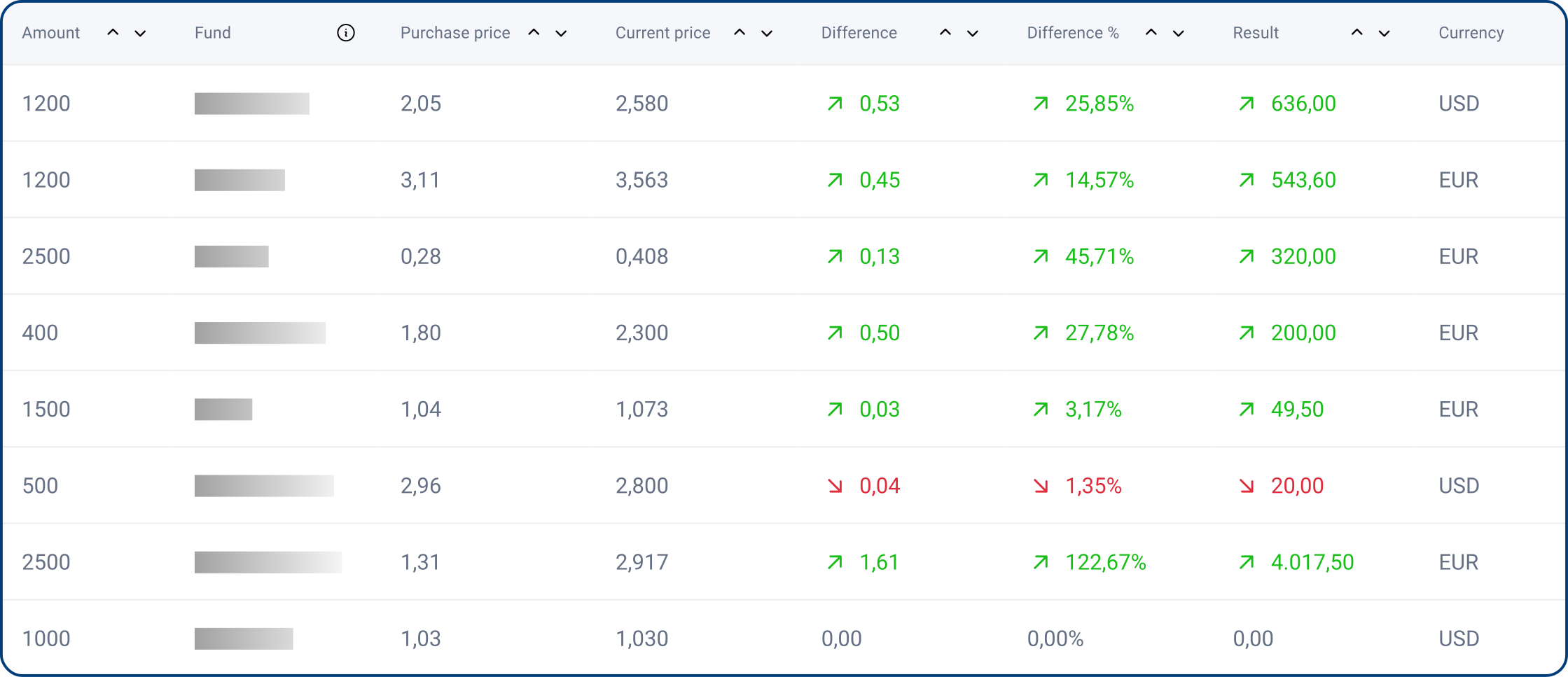








You can follow our portfolio and take advantage of it. Our portfolio is not a buy recommendation.

Discover high-potential shares under £10. Backed by results. Updated weekly.

35% return in 2025. Join members who consistently outperform the market.

The many benefits of our exclusive platform

24/7 access to our portfolio

As a subscriber, you have round-the-clock access to our website, where you can view all the information about our current portfolio, including the latest results.

Regular portfolio updates

We regularly send subscribers our update, where we cover the overall economic outlook and news about stocks in our portfolio.

Support from our analysts

As a subscriber, you can always email our team with any general questions about our portfolio.

Featured in:

Latest updates & analyses

Updates

Oil Price Falls Further as Attention Shifts to the Economy

Geopolitical tensions in the Middle East appear to be easing further. The United States and Iran have agreed to end the fighting around the Strait of Hormuz and resume peace talks. In addition, shipping through the crucial strait has restarted, reducing concerns about disruptions to global oil supply. As a result, the oil price has continued to fall in recent days. This is positive for the inflation outlook and the global economy. For investors, that is good news. A lower oil price not only means lower fuel and transport costs for companies, but also increases the likelihood that inflation will cool further in the coming months. In time, this could give central banks more room to cut interest rates. Shares Under Ten therefore remains positive on companies that benefit from a normalising economy and lower energy costs. Stock markets appear to be gradually entering a holiday mood. This is a period in which investors can sometimes become euphoric and share prices can rise sharply, but there are also years in which investors decide they have had enough and move to the sidelines. That is often when attractive opportunities arise. Buyers go on holiday, while sellers sometimes sell at lower, and possibly too low, prices. At Shares Under Ten, we therefore have our radar switched on at full strength. This week, attention will mainly shift to the US macroeconomic calendar. On Wednesday, the ISM Manufacturing PMI will be published, while Bank of England Governor Andrew Bailey and Fed Governor Christopher Waller are both scheduled to speak. On Thursday, the important US labour market figures will follow, including job growth, unemployment and average wage growth. These figures could be important for expectations around the Federal Reserve’s interest rate policy. On Friday, US stock markets will remain closed due to Independence Day, the 4th of July. As a result, trading activity is expected to be lower towards the end of the week. Sunny Optical On 24 June, Sunny Optical held its Investor Day and presented a broader strategy under the theme “Optics + AI”. While the company was previously mainly known as a supplier of smartphone cameras, it is now increasingly focusing on new growth markets such as AI glasses, XR, robotics, automotive applications, optical interconnects and optical solutions for data centres. The company also announced that Vice President Ma Jianfeng will step down on 1 July. According to Sunny Optical, this is not the result of any conflict or difference of opinion with the board of directors and does not change the company’s strategic direction. At the same time, the past week was volatile on the stock market. Technology shares came under pressure worldwide after investors became more critical of the enormous investments that AI companies will have to make in the coming years. This raised doubts about whether the expected returns can justify these investments. Sunny Optical was also dragged down in this sell-off and lost significant value in a short period of time. In addition, the company announced that it will issue bonds to refinance existing debt. This is mainly a financial optimisation and does not change the underlying investment case. Shares Under Ten therefore sees the recent share price decline mainly as a result of worsening sentiment around AI and technology, rather than a deterioration in the company’s fundamental outlook. At the same time, we acknowledge that sentiment can play an important role in the short term. The stock has been highly volatile in recent weeks. For now, we are giving Sunny Optical the benefit of the doubt, but we continue to monitor developments closely. Savills This stock was only recently added to the portfolio, and so far the timing appears to have been good. Since our purchase, the share price is already almost 7% higher. This week, the real estate adviser published a new analysis of the UK housing market. It shows that the number of newly built homes is likely to remain well below the political target in the coming years. Higher construction costs, more expensive financing, limited planning approvals and worsening affordability continue to hold back the housing market. Despite this cautious outlook, the stock reacted positively. In our view, the update mainly confirms that a broad recovery in the real estate market is likely to be gradual. That is exactly the kind of environment in which Savills stands out. The company is no longer solely dependent on real estate transactions, but is increasingly earning income from advisory, research, property management and capital markets services. This makes the business model more robust than many investors realise. We therefore remain positive on Savills. The recent share price increase strengthens our belief that the market is gradually starting to appreciate the improved quality of the company, while we still see upside potential. Marston’s After the publication of its half-year results in May, Marston’s initially fell back somewhat, but the share price now appears to be finding cautious support again. This week, it was also notable that Aurelio Holding B.V., a Dutch investment company, has built a 3.97% stake in Marston’s. Such a disclosure is interesting because investors in the United Kingdom are required to make their holding public once the 3% threshold is crossed. The fact that a professional investor now owns almost 4% of the shares can be seen as a sign that larger parties also see value in the British pub chain. Shares Under Ten remains positive on the long-term story. Marston’s benefits from improving consumer spending, a further reduction in debt and an attractively valued property portfolio. The renewed institutional interest fits well with our own positive view. We therefore continue to hold the shares in the portfolio with confidence. Rolls-Royce There was also plenty of news around Rolls-Royce last week. On 25 June, the company announced that improved aircraft and engine monitoring will be introduced on Bombardier business jets. This fits within the broader shift towards digital service revenues and predictive maintenance. In addition, Rolls-Royce SMR announced on 26 June plans for a

Read more >
Updates

Oil Price Falls Further as Attention Shifts to the Economy

Geopolitical tensions in the Middle East appear to be easing further. The United States and Iran have agreed to end the fighting around the Strait of Hormuz and resume peace talks. In addition, shipping through the crucial strait has restarted, reducing concerns about disruptions to global oil supply. As a result, the oil price has continued to fall in recent days. This is positive for the inflation outlook and the global economy. For investors, that is good news. A lower oil price not only means lower fuel and transport costs for companies, but also increases the likelihood that inflation will cool further in the coming months. In time, this could give central banks more room to cut interest rates. Shares Under Ten therefore remains positive on companies that benefit from a normalising economy and lower energy costs. Stock markets appear to be gradually entering a holiday mood. This is a period in which investors can sometimes become euphoric and share prices can rise sharply, but there are also years in which investors decide they have had enough and move to the sidelines. That is often when attractive opportunities arise. Buyers go on holiday, while sellers sometimes sell at lower, and possibly too low, prices. At Shares Under Ten, we therefore have our radar switched on at full strength. This week, attention will mainly shift to the US macroeconomic calendar. On Wednesday, the ISM Manufacturing PMI will be published, while Bank of England Governor Andrew Bailey and Fed Governor Christopher Waller are both scheduled to speak. On Thursday, the important US labour market figures will follow, including job growth, unemployment and average wage growth. These figures could be important for expectations around the Federal Reserve’s interest rate policy. On Friday, US stock markets will remain closed due to Independence Day, the 4th of July. As a result, trading activity is expected to be lower towards the end of the week. Sunny Optical On 24 June, Sunny Optical held its Investor Day and presented a broader strategy under the theme “Optics + AI”. While the company was previously mainly known as a supplier of smartphone cameras, it is now increasingly focusing on new growth markets such as AI glasses, XR, robotics, automotive applications, optical interconnects and optical solutions for data centres. The company also announced that Vice President Ma Jianfeng will step down on 1 July. According to Sunny Optical, this is not the result of any conflict or difference of opinion with the board of directors and does not change the company’s strategic direction. At the same time, the past week was volatile on the stock market. Technology shares came under pressure worldwide after investors became more critical of the enormous investments that AI companies will have to make in the coming years. This raised doubts about whether the expected returns can justify these investments. Sunny Optical was also dragged down in this sell-off and lost significant value in a short period of time. In addition, the company announced that it will issue bonds to refinance existing debt. This is mainly a financial optimisation and does not change the underlying investment case. Shares Under Ten therefore sees the recent share price decline mainly as a result of worsening sentiment around AI and technology, rather than a deterioration in the company’s fundamental outlook. At the same time, we acknowledge that sentiment can play an important role in the short term. The stock has been highly volatile in recent weeks. For now, we are giving Sunny Optical the benefit of the doubt, but we continue to monitor developments closely. Savills This stock was only recently added to the portfolio, and so far the timing appears to have been good. Since our purchase, the share price is already almost 7% higher. This week, the real estate adviser published a new analysis of the UK housing market. It shows that the number of newly built homes is likely to remain well below the political target in the coming years. Higher construction costs, more expensive financing, limited planning approvals and worsening affordability continue to hold back the housing market. Despite this cautious outlook, the stock reacted positively. In our view, the update mainly confirms that a broad recovery in the real estate market is likely to be gradual. That is exactly the kind of environment in which Savills stands out. The company is no longer solely dependent on real estate transactions, but is increasingly earning income from advisory, research, property management and capital markets services. This makes the business model more robust than many investors realise. We therefore remain positive on Savills. The recent share price increase strengthens our belief that the market is gradually starting to appreciate the improved quality of the company, while we still see upside potential. Marston’s After the publication of its half-year results in May, Marston’s initially fell back somewhat, but the share price now appears to be finding cautious support again. This week, it was also notable that Aurelio Holding B.V., a Dutch investment company, has built a 3.97% stake in Marston’s. Such a disclosure is interesting because investors in the United Kingdom are required to make their holding public once the 3% threshold is crossed. The fact that a professional investor now owns almost 4% of the shares can be seen as a sign that larger parties also see value in the British pub chain. Shares Under Ten remains positive on the long-term story. Marston’s benefits from improving consumer spending, a further reduction in debt and an attractively valued property portfolio. The renewed institutional interest fits well with our own positive view. We therefore continue to hold the shares in the portfolio with confidence. Rolls-Royce There was also plenty of news around Rolls-Royce last week. On 25 June, the company announced that improved aircraft and engine monitoring will be introduced on Bombardier business jets. This fits within the broader shift towards digital service revenues and predictive maintenance. In addition, Rolls-Royce SMR announced on 26 June plans for a

Read more >
Analyses

A Real Estate Recovery Hidden in Plain Sight

Savills’ share price has moved remarkably closely with interest rates for years. On days when yields rise, the stock almost automatically comes under pressure. For many investors, the reasoning is simple: higher financing costs lead to fewer real estate transactions, and therefore lower revenues for a real estate adviser. That view has largely shaped sentiment around Savills in recent years. At the same time, the numbers tell a different story. Revenue is growing, profits are developing steadily, and an increasing share of the business is less dependent on transactions. For that reason, Sharesunderten is taking a position. We are buying 200 shares of Savills. Profile Savills is a British real estate advisory firm originally founded in London in 1855. What began as a traditional land and property agency has grown into a global service provider within the real estate sector. Savills’ growth has taken place in phases. For a long time, the focus was mainly on the United Kingdom, but from the 1990s onward, and especially after its stock market listing in 1989, international expansion accelerated. The company built a strong position in Asia-Pacific, with significant operations in markets such as China, Hong Kong and Australia. In Europe, the network was expanded further, while its presence in the United States remained relatively limited for a long time. That is precisely where Savills has been trying to gain ground in recent years. Today, Savills consists of several business lines. The best-known activity is real estate transaction advisory, where the company acts as adviser in the purchase and sale of commercial and residential property. This has traditionally been the most cyclical division, as revenues depend on transaction volumes and therefore on factors such as interest rates and market sentiment. In addition, Savills provides consultancy services, including valuations, strategic advice and market research for investors and companies. An increasingly important pillar is property and facilities management. In this area, Savills manages real estate portfolios for clients and handles operational management, maintenance and rent administration, among other services. These activities generate recurring revenues and are less sensitive to fluctuations in the property market. Finally, Savills is active in investment management, where it manages real estate funds and mandates for institutional investors. Results Savills’ 2025 results present a picture that clearly differs from the negative sentiment surrounding the stock. Revenue rose by 6% to £2.55 billion, while underlying profit before tax increased by more than 11% to £145 million. Earnings per share grew even faster, rising 16.6% to 77.2 pence, pointing to clear margin improvement and operating leverage. This improvement was partly driven by earlier cost measures and a more efficient organisation. Notably, the growth was broad-based. The transaction business reported revenue growth of 4%, while profit in that division increased by 13%. The less cyclical activities, such as property management and consultancy, grew faster, with revenue up 8% and profit up 15%. This makes the earnings model visibly more stable. The cash position also remains solid at £168 million, while the dividend was increased by almost 12% to 33.8 pence. Looking ahead, Savills expects a gradual recovery in the real estate market in 2026. The transaction pipeline is improving, and profitability in the transaction division should continue to recover. At the same time, the more stable business lines continue to grow. Analysts broadly agree with this view. They are not expecting a rapid recovery in transaction volumes, but they do recognise that Savills’ profit development is more resilient than the market often assumes, with medium-term earnings growth estimated at around 10% to 12% per year. Revenue by division. Source: Savills.Profit before tax by division. Source: Savills. In a recent update, management reported a strong quarter that came in slightly ahead of its own expectations. In the commercial real estate market, the United States remained particularly strong, with investment volumes increasing by more than 20% year-on-year. Asia-Pacific also delivered a strong quarter, with growth of 16%, while EMEA recorded a 4% decline. Within the residential activities, Savills initially saw a strong start to the year in the UK. However, since the outbreak of the conflict in the Middle East, buyers and sellers have become more cautious. This has led to longer transaction timelines. The number of agreed transactions still rose by 1% in the first quarter. Looking ahead, Savills remains positive, although management is allowing for longer transaction timelines due to elevated geopolitical uncertainty. Management has therefore maintained its outlook for 2026 and expects the profit split between H1 and H2 to be similar to that of 2025. Acquisition Alongside its annual results, Savills also announced an acquisition. Eastdil Secured represents one of the largest strategic steps in the company’s history. Eastdil is not a traditional real estate adviser, but rather a real estate investment bank. Whereas Savills has traditionally focused mainly on broking transactions, managing properties and providing advisory services, Eastdil operates on the financial side of the market. The company advises on major real estate deals, mergers and acquisitions, joint ventures and, most importantly, financing, including debt structures and loans. With this acquisition, Savills aims to become less dependent on pure transaction activity and to strengthen its position in real estate capital markets. This is precisely where Eastdil earns its money. By adding Eastdil, Savills moves higher up the value chain: from a company that primarily assists with transactions to a player that can advise clients across the full financial and strategic process of real estate investment. The deal also strengthens Savills’ position in the United States, the world’s largest real estate market, where Eastdil is a dominant player. As a result, the nature of Savills’ revenue also changes. Eastdil generates a large share of its revenue from activities such as debt advisory and structured finance, which are less directly dependent on the number of property transactions and often continue even in weaker markets, for example when refinancing is required. This could make Savills’ overall earnings profile more stable. At the same time, the acquisition also brings risks. It is a major

Read more >
Updates

Relief in Oil, Political Noise in London

The past week was largely shaped by two opposing forces: relief over lower energy prices and renewed caution around interest rates and inflation. The first round of talks between Iran and the United States produced a roadmap for further negotiations. The goal is to work toward a more definitive peace agreement within the next sixty days. For markets, the most important outcome was an agreement aimed at preventing incidents and miscommunication around shipping traffic in the Strait of Hormuz. Oil prices reacted by moving lower, providing immediate relief to inflation concerns. However, this is not a situation where investors can simply erase geopolitical risk from the equation. Israel is not part of the negotiations, and security conditions in Lebanon remain fragile. That captures the current market environment well: reduced short-term stress around oil helps, but the underlying risks have not disappeared. As a result, some areas of the market welcomed the news while investors remained hesitant to draw broad conclusions. Adding to the uncertainty, political developments in the United Kingdom came into focus. According to British media reports, Prime Minister Keir Starmer is expected to announce a timeline for his departure following growing pressure within the Labour Party and the return of Andy Burnham to Parliament. For financial markets, this matters primarily through the British pound, government bonds, and domestically focused UK equities. An orderly leadership transition could limit the damage, but fresh political uncertainty arrives at a time when the UK is already grappling with interest rates, consumer purchasing power, and budget constraints. In both the United States and the United Kingdom, central banks left interest rates unchanged, but their message remained cautious. Inflation has not yet been defeated, and investors should not assume rate cuts are imminent. In the UK, two policymakers even voted in favor of a rate hike despite softer inflation data for May. Smaller and rate-sensitive companies could recover strongly if rate expectations begin to shift, but they remain vulnerable as long as central banks maintain a restrictive stance. This week, investors are primarily focused on the United States. Attention will center on the PCE inflation report, the Federal Reserve’s preferred inflation gauge. The data is scheduled for release on Thursday. Alongside our existing portfolio, we are currently evaluating a new company within the real estate sector—but not a traditional property owner. Instead, the company generates revenue through services related to real estate. As a result, the stock remains highly sensitive to interest rate expectations. When rates rise, the market tends to punish the shares. When rates fall, higher valuations typically follow. What interests us is that the business appears to be gradually reducing its dependence on rate movements. Its service offering is becoming broader, revenue streams are becoming more stable, and yet the market still seems to value the company as though it were entirely tied to real estate cycles and interest rate fears. That disconnect may create an opportunity. We will share our full analysis with members via email in the near future. BP For BP, the week was largely driven by developments in the oil market. The roadmap for continued peace negotiations between Iran and the United States put downward pressure on oil prices as investors priced in less risk around the Strait of Hormuz. For BP, this cuts both ways. Reduced geopolitical tension is positive for inflation and overall market sentiment, but lower oil prices can also dampen cash flow expectations. For us, BP remains primarily a story of execution. The market wants proof that the company can maintain discipline and continue delivering attractive shareholder returns even in a more normal oil price environment. Lower oil prices are not necessarily negative if they coincide with lower geopolitical risk and softer inflation, but they do reduce the margin for additional shareholder distributions. We continue to view BP as a company where evidence matters more than promises: consistent execution, stability within management, and sufficient free cash flow, even without exceptionally high oil prices. Rolls-Royce Rolls-Royce received further support from the nuclear sector during this period. The company was selected for three small modular reactor projects in Sweden and also entered into a partnership with British and Japanese nuclear organizations focused on advanced reactor technology. This is meaningful because it further strengthens Rolls-Royce’s position in the small modular reactor market beyond its home market. What matters most to us is repeatability. Investors are no longer valuing Rolls-Royce solely on the aviation cycle; increasingly, the question is whether new growth engines can scale successfully. The Swedish selection confirms that the technology is being taken seriously on an international level. At the same time, this remains a long-term story. Reactor projects involve lengthy timelines, political risks, and execution challenges. Shares Under Ten therefore views this development as positive for the strategic investment case, though it is unlikely to materially affect earnings in the short term. Deceuninck On June 19, Deceuninck released a transparency notification showing that Gramo, Holve, and Francis Van Eeckhout had jointly surpassed the 30% voting rights threshold. Their combined position now stands at 30.52%. This matters because ownership structure and control are becoming increasingly important factors in the Deceuninck story. From an investment perspective, the stock is now viewed less as a traditional industrial small-cap and more as a situation involving control, valuation, and potential takeover dynamics. Operationally, the announcement changes nothing regarding demand for window and door systems, margins, or a recovery in European markets. However, for minority shareholders, shifts in voting power and influence remain highly relevant. Shares Under Ten sees this development as one that warrants close attention to valuation, governance, and the protection of minority shareholder interests. Global Dominion Access Global Dominion Access has struggled somewhat in recent months. There was little significant company-specific news over the past week, which largely reflects the current situation: no major problems, but also no obvious catalyst that would force the market to reassess the stock. For Shares Under Ten, this does not change the core investment thesis. This is the type

Read more >
Updates

Framework agreement between the US and Iran brings relief to the stock market

Last night, we were surprised by news from the Middle East. US President Donald Trump announced that the United States and Iran have reached an agreement. According to Trump, the Strait of Hormuz will be fully reopened and the US naval blockade will be lifted. Pakistani Prime Minister Shehbaz Sharif also confirmed that both parties have agreed to a permanent end to military operations. The official signing is expected to take place in Switzerland on 19 June.

Read more >
Breaking news

BREAKING NEWS: We Are Taking a Position Again!

Our previous purchase of JD Logistics proved to be a successful investment. Following our initial buy recommendation, the stock rose sharply, allowing us to realise a 25% gain in just one month. This type of company requires an active investment approach, which is why we have continued to monitor the stock closely over the past few weeks. Our original investment thesis remains fully intact. JD Logistics still operates one of the most advanced logistics networks in China, with strong positions in automation, supply chain software, and AI-driven infrastructure. At the same time, the valuation remains exceptionally low. The company continues to trade at an EV/EBITDA multiple of around 3.5x, despite strong free cash flow growth and a positive net cash position. We also believe a potential takeover by parent company JD.com cannot be ruled out. Just as we did previously, we are adding 1,500 shares to the portfolio. Following its quarterly earnings release on 12 May, JD Logistics initially rallied strongly. The company reported revenue growth of 29% to RMB 60.6 billion, while profit increased by more than 40%. Gross profit also showed a substantial improvement. Operationally, the results were particularly impressive. JD Logistics continues to expand aggressively outside China. During the first quarter, JoyExpress was launched across major European markets, including the Netherlands, Germany, France, and the United Kingdom. In addition, the company continues to invest heavily in automation, artificial intelligence, and robotics throughout its logistics network. Despite the strong results, market sentiment quickly turned negative again after the initial share price surge. Investors appear to be focusing primarily on the company’s rising cost base. JD Logistics is investing heavily in personnel, warehouses, freight capacity, and technology. As a result, operating expenses increased significantly. While the market initially reacted positively to the company’s growth figures, attention soon shifted almost entirely towards lower margins and the substantial level of ongoing investment. Conclusion Sharesunderten believes the market is once again focusing too heavily on the short term. In our view, JD Logistics’ operational position continues to strengthen. Approximately 68% of revenue now comes from external customers outside JD.com, allowing the company to evolve into an independent logistics platform rather than merely serving as JD.com’s internal delivery arm. Its international expansion is also progressing at an impressive pace. JD Logistics now operates more than 1,600 owned warehouses and maintains a logistics network covering virtually every region in China. At the same time, its European network is being rolled out rapidly. We believe this combination once again creates an attractive opportunity. Operational performance remains strong, while the share price continues to be driven largely by short-term market sentiment. We therefore do not view the recent pullback as a deterioration of the long-term investment case, but rather as a new opportunity to acquire a high-quality infrastructure business at an exceptionally attractive valuation. We are reiterating our Buy recommendation. Major ShareholdersJD.com: 63%Core Trust: 7.5% Fundamental DataCompany Name: JD Logistics, Inc.Ticker: 2618ISIN: KYG5074S1012Sector: LogisticsExchange: Hong Kong Stock ExchangeEUR/HKD Exchange Rate: 9.1Share Price (9 June): HKD 12.67 (£1.20)52-Week Low: HKD 10.2052-Week High: HKD 16.76Market Capitalisation: HKD 88.9 billion (£8.5 billion)Net Cash Position: HKD 6.5 billionPrice-to-Earnings Ratio (P/E): 7.0xDividend Yield: 0.0%Next Results: AugustWebsite: https://ir.jdl.com/?lang=en

Read more >

Success stories:

Our portfolio