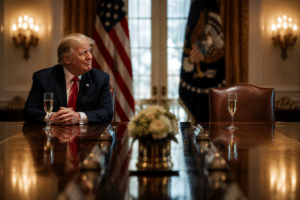

Trump promises a deal, and the market still believes him
Over the past few weeks, a familiar pattern has started to emerge. President Trump says that an agreement with Iran over the Strait of Hormuz is close, oil prices fall and equity markets breathe a sigh of relief. Last week, exactly the same thing happened. Trump and Treasury Secretary Scott Bessent suggested that an agreement could be reached within days. Brent crude fell sharply on the comments and ended the week around 8% lower. There was just one problem: once again, the promised deal failed to materialise. As a result, we are becoming increasingly sceptical whenever Washington claims that a solution is imminent. Financial markets continue to take these statements seriously, while the negotiations themselves appear to be considerably more complicated. Over the weekend, Iran once again set out tough conditions for reopening the Strait of Hormuz. Tehran wants, among other things, an end to the US naval blockade, the withdrawal of American forces from the surrounding region and an easing of sanctions. It is also demanding financial compensation. That is still a long way from the US position, which is essentially that Hormuz should simply return to being a freely accessible international shipping route. Adding to the uncertainty, the two sides are even giving different accounts of how the negotiations are taking place. Trump regularly speaks as though Washington is negotiating directly with Tehran, while Iran insists that talks are being conducted through Oman. There does appear to be some movement, but we would only consider an agreement truly meaningful once the first oil tankers are once again able to pass through the Strait of Hormuz without disruption. Until then, a single statement, attack or failed round of negotiations could just as easily send oil prices sharply higher again. Meanwhile, a major surprise came from the United States last Friday. The economy lost 23,000 jobs in July, while economists had expected around 80,000 new jobs to be created. That is a substantial miss and another indication that the US economy is no longer performing as strongly across the board as previously thought. As a result, markets are now assigning a lower probability to another interest-rate increase from the Federal Reserve. That does not mean the debate is over. Fed Chair Kevin Warsh has made it clear that price stability remains the number-one priority for now. That is precisely why Wednesday is likely to be the most important trading day of the week, when the latest US inflation figures are released. Markets expect core inflation of 0.2% month on month and 2.5% year on year. Headline inflation is expected to rise by 0.1% month on month and 3.4% year on year. Following the weak labour-market data, softer-than-expected inflation could further strengthen the case for less monetary pressure. A hotter reading, however, could quickly dampen those expectations. Thursday will then bring US producer-price inflation and UK GDP figures. The macroeconomic calendar is therefore somewhat lighter than in recent weeks, but certainly no less relevant. Wednesday in particular could prove important for interest rates, the dollar and, as a result, equity markets. Within the portfolio, we locked in another excellent gain last week. We sold our position in Auction Technology Group, which had risen by around 50% since we bought the shares in February. An excellent return in a relatively short period of time. We may already have identified our next candidate. It is a Dutch-listed company that, in our view, was punished far too heavily following its half-year results. The unique data held by the company could become increasingly valuable as technological developments continue. Keep an eye on your inbox. Rolls-Royce The strong results continue to go down well with analysts. Since the publication of the figures, we have seen a steady stream of price-target upgrades. Rothschild & Co Redburn, for example, issued a Buy recommendation last week with a target price of 1,900p, representing more than 20% upside from the share price at the time. Other analysts have also raised their targets towards the 1,700p to 1,850p range. This supports our view that the strong operational performance still leaves room for further upside. The market has already recognised a large part of Rolls-Royce’s remarkable turnaround, but analysts clearly believe there is more potential ahead. The shares also reached another record high last week. We are therefore continuing to hold the position in the portfolio. Grab Holdings The quarterly results were strong and have reinforced our confidence in the company’s development. Revenue rose by 22% in the second quarter to $997 million, while Grab reported net profit of $235 million. Operational progress was also impressive. Grab delivered a record quarter for adjusted EBITDA and subsequently raised its full-year 2026 guidance to between $720 million and $740 million. The company also increased its full-year revenue outlook and announced a new $750 million share-buyback programme. We see that as an important signal. The business is growing strongly, profitability is improving and the company now has sufficient financial capacity to return capital to shareholders as well. The shares initially responded positively, although the market remains demanding. We are primarily focused on the underlying business performance, and that is clearly moving in the right direction. Following the weak share-price performance of recent months, this is exactly the kind of confirmation we had been waiting for. Members who do not yet own the shares may now consider adding them to their portfolio. BP The strong momentum continues. Second-quarter results were excellent, while management continues to work hard on simplifying the portfolio and strengthening the balance sheet. The restructuring of the business is clearly continuing, with non-core assets being sold and the proceeds being allocated more selectively. We saw another example of that strategy this week. BP is selling a 20% stake in the Manakin gas field in Trinidad and Tobago to local state-owned energy company NGC. At the same time, BP is increasing its exposure to the region by acquiring a 70% stake in the Calypso gas project from Woodside. That is exactly what management