

You can follow our portfolio and take advantage of it. Our portfolio is not a buy recommendation.

A Bank in Recovery

Vanquish

Since taking office in August 2023, Vanquis Banking Group CEO Ian McLaughlin inherited anything but a clean slate. Years of high costs, ongoing legal disputes, and strategic missteps had left deep scars. What followed was not a cautious adjustment, but a hard reset. He aggressively cut the cost base, dealt with legacy issues from the past, and did not shy away from painful decisions that had previously been postponed. Where the engine had once been sputtering beneath the surface, the company is now clearly cleaning house. Not without difficulty, but with a clear message: this is a bank that is no longer managing its problems, but solving them.

We already had this stock on our radar, but wanted to wait for the first-quarter results, as these would be decisive for the future share price direction. The results positively surprised us across the board. Perhaps even more important than the quarterly figures themselves is the fact that Vanquis maintained its full-year outlook. The bank still expects:

  • further growth of the loan portfolio towards more than £3.3 billion
  • a low double-digit return on tangible equity
  • further improvement in the cost-income ratio

However, the market does not yet seem to recognize this and is still pricing in a scenario as if the recovery is not sustainable. Sharesunderten is taking advantage of this opportunity and is opening a position. We are buying 1,500 shares.
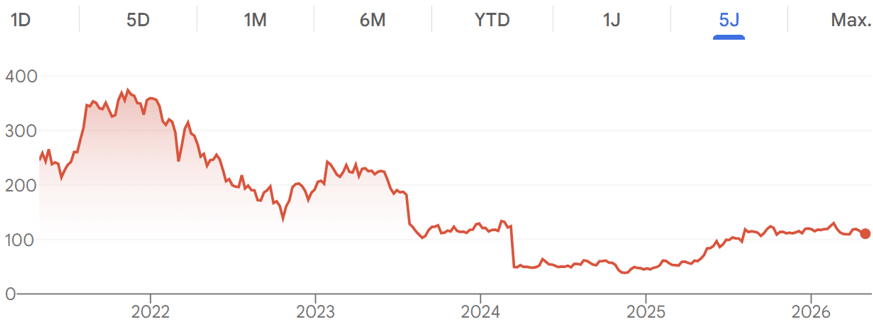
Vanquis share price performance over the past five years. Source: Google.

Chaos

For years, Vanquis found itself in a state of chaos, with problems piling up. The bank was flooded with claims from customers alleging that loans had been irresponsibly issued, often driven by claims management companies. The legal pressure became so intense that more than £130 million in exceptional charges had to be taken in 2024.

At the same time, the cost base had spiraled out of control. With a cost-income ratio approaching 90%, nearly every pound of revenue was being absorbed by inefficiencies, IT issues, and a bloated organization. On top of that came weak profitability. In 2024, the bank still reported a loss of £138 million, while return on equity was deeply negative.

The underlying issue was not only costs, but also risk management. The loan portfolio experienced relatively high losses and came under increasing pressure from regulators, further fueling the stream of claims. What emerged was a vicious cycle in which poor credit quality led to claims, claims led to higher costs, and higher costs led to even weaker results.

The situation was worsened by a lack of strategic focus. Growth was pursued without sufficient discipline, legacy operations remained in place for too long, and clear decisions were continuously postponed. For investors, this resulted in a loss of confidence.

Profile

Vanquis Banking Group is not a traditional bank, but a specialist lender focused on consumers who struggle to access financing through mainstream banks. The core of its business model lies in providing credit, particularly through credit cards, to customers with weaker or limited credit histories.

This segment, often referred to as non-standard or near-prime, offers higher margins but also requires stricter risk management. In addition to credit cards, the company is active in vehicle finance through its Moneybarn brand, primarily financing used cars.

Vanquis also has a rapidly growing second-charge mortgage division, allowing customers to borrow against the equity in their homes. On the funding side, the bank operates its own savings platform, attracting retail deposits that provide a relatively stable and low-cost funding source for the loan portfolio.

In addition, Vanquis is investing in digitalization and customer engagement through Snoop, a fintech app that uses open banking technology to help customers gain insight into their spending and save money. With this, the bank aims not only to provide credit, but also to play a broader role in the financial lives of its customers.

Results

In the first quarter of 2026, Vanquis Banking Group demonstrated that last year’s recovery is continuing. Gross interest-earning receivables increased by 4% to £2.93 billion. On an annual basis, growth reached 27%. Net receivables also rose by 4% to £2.80 billion.

Credit card operations in particular continue to perform strongly and have now delivered growth for the fourth consecutive quarter, supported by higher credit limit utilization, strong customer retention, and continued inflow of new customers. In addition, the second-charge mortgage division continued to grow towards approximately £680 million.

The net interest margin declined from 16.1% to 15.6%, but this fully aligns with management’s strategy. Vanquis is deliberately shifting toward lower-risk products that also generate lower interest income. More importantly, in our view, the risk-adjusted margin remained stable at 9.4%.

This demonstrates that the balance between return and risk remains healthy, and that the lower margins are largely offset by improved credit quality and a lower cost of risk.

Operational progress also remains visible. Management stated that Vanquis was once again profitable in the first quarter and remains on track to achieve a low double-digit return on tangible equity in 2026.

At the same time, the company continues to focus heavily on improving efficiency. Through the Gateway transformation program, Vanquis expects to achieve an additional £23 million to £28 million in cost savings during 2026 and 2027, supported by further automation, AI-driven customer service, and a more modern technology platform.

Despite strong growth, the balance sheet remains solid. The CET1 ratio stood at 15.9%, slightly lower than at the end of 2025 as capital is actively being deployed to support further loan portfolio growth. Nevertheless, Vanquis still maintains substantial buffers above required capital levels, keeping the balance sheet robust while allowing room for continued growth.

Forecasts
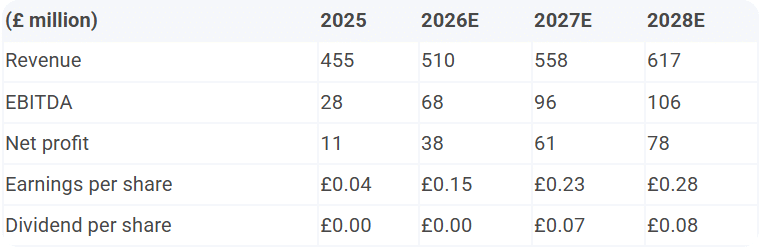
Forecasts for the coming years.

While 2024 and also 2025 were still dominated by write-downs, settlements, and legal costs, these burdens are now expected to be largely behind the company.

Revenue is expected to grow steadily, in line with management’s vision of pursuing growth without compromising risk discipline. Significant cost reductions have been implemented in recent years, which is reflected in strongly rising EBITDA and net profit. Earnings per share are following the same trend.

As profitability improves, dividend payments are also expected to resume from 2027 onward.

Conclusion

We are positive on Vanquis Banking Group because the company has managed to break free from a structurally weak period in a relatively short time and is now clearly demonstrating recovery. Yet this recovery is not reflected in the share price in any meaningful way.

While the bank returned to profitability in 2025, significantly improved its balance sheet, and greatly increased efficiency, the valuation still lags as if nothing has changed.

This is where the tension in the story lies. Vanquis operates in a niche market of so-called underserved customers, where demand remains structurally present while supply has declined due to stricter regulation and the disappearance of competitors. This creates room for controlled growth without immediate pressure on credit quality.

Management’s strategy is intentionally conservative: first strengthen credit quality further, then accelerate growth. At the same time, the company continues to reduce costs and scale up its core operations. Within this strategy, credit cards and second-charge mortgages stand out in particular, as growth accelerates and returns improve.

This is exactly the type of combination of growth and margins that can drive earnings higher over time.

But the real imbalance lies in the valuation. The stock trades well below tangible book value of GBX 169 per share and at an expected 2027 price-to-earnings ratio of just 5x.

Simply put, the market is still pricing in a scenario as if the recovery is not sustainable. Just returning to book value alone would imply upside potential of approximately 50%.

If current forecasts are even partially achieved, that discount appears difficult to justify. Nevertheless, the risks remain clearly present. This is a story that depends entirely on execution, credit discipline, and market sentiment.

And following the quarterly figures, we were certainly not the only ones reacting positively. Analysts at Berenberg issued a Buy recommendation today with a price target of GBX 165. This is not a firm that becomes enthusiastic based on a single quarterly update. It indicates that professional investors are increasingly seeing signs that Vanquis is undergoing a structural recovery.

Perhaps the most interesting aspect is sentiment itself. This is a heavily beaten-down stock where investor confidence still needs to be rebuilt gradually. That is precisely what creates the asymmetry: recovery in the numbers, silence in the share price.

Sharesunderten bases its view on the sum of the facts and sees a clear imbalance in the risk-reward profile emerging: a heavily punished valuation versus a company that is operationally recovering.

At current levels, this creates an attractive entry opportunity, with an initial price target of GBX 160, where re-rating could accelerate rapidly once the market truly starts believing in the recovery.

The author holds a position in Vanquis.

Fundamental data

Major Shareholders
Van Eck Associates: 9.0%
Schimmelbusch: 3.5%
BlackRock: 3.0%

Fundamental Data
Company Name: Vanquis Banking Group PLC
Ticker: VANQ
ISIN: GB00B1Z4ST84Sector: Financials
Exchange: London Stock Exchange
Share Price (12 May): 114 GBX
52-week Low: 62.1 GBX
52-week High: 132 GBX
Market Capitalization: £278 million
Price/Earnings Ratio: 5x
Dividend Yield: 0.0%
Half-Year Update: August
Website: https://www.vanquis.com/investors

See also

Updates

Earnings Season Begins as Middle East Tensions Rise

After several relatively quiet weeks, financial markets were once again shaken by geopolitical developments. US President Donald Trump announced that negotiations with Iran had come to an end for the time being, causing tensions in the Middle East to escalate once again. Oil prices moved higher, bond yields edged up, while equity markets came under pressure. It served as another reminder of just how sensitive financial markets remain to geopolitical events. Uncertainty increased further after the United States launched additional strikes against military targets in Iran. According to Washington, the attacks were aimed at facilities believed to threaten shipping through the Strait of Hormuz. President Trump also announced on Monday that the United States intends to safeguard the Strait of Hormuz by introducing a 20% levy on cargo passing through the waterway. Iran immediately rejected the proposal, leaving the outlook highly uncertain. Until greater clarity emerges, oil prices are likely to remain highly sensitive to further developments. Meanwhile, earnings season is now officially underway. Later today, the major US banks will traditionally kick off reporting season, giving investors the first indication of how corporate America performed during the first half of the year. In Europe, attention will later shift to companies such as ASML. Within our portfolio, ME Group published a strong trading update yesterday, which we discuss in more detail below. Most of our other portfolio companies will report later this month and into early August, when earnings season gathers momentum. On the macroeconomic front, investors will primarily focus on US inflation data today. Producer price inflation follows on Wednesday, while Federal Reserve Chair Kevin Warsh is also scheduled to testify before Congress. On Thursday, the UK will publish its latest GDP figures. The US inflation data will be particularly important for expectations surrounding the Federal Reserve’s interest rate policy. If inflation continues to moderate, expectations for a rate cut later this year are likely to strengthen. As a result, this week could prove important not only for corporate earnings but also for the direction of financial markets during the second half of the year. Envipco When we added Envipco to the portfolio, we did so because we believed strongly in its long-term growth potential. The rollout of deposit return schemes across Europe represents an attractive structural growth opportunity, and the company appeared well positioned to benefit. At the same time, we recognised that execution would be critical. Unfortunately, this is precisely where the company has disappointed. The publication of its annual report has now been postponed several times: first from late April to 15 May, then to 10 July, and now once again to 11 July. Although Envipco maintains that its previously published preliminary results remain unchanged, we consider this sequence of delays unacceptable for a listed company. Strong corporate governance and transparent communication are just as important to us as growth potential. When a company repeatedly fails to deliver its financial reporting on time, it undermines our confidence. We have therefore decided to exit our position. While the long-term opportunity may still exist, we believe there are currently better places to allocate our capital. Auction Technology Group News flow surrounding the company remained relatively quiet over the past week, but that is certainly not a negative development. In fact, during periods without major company-specific news, we have seen market sentiment gradually improve. The share price has been recovering steadily over recent weeks and appears to be rebuilding momentum. In addition, RBC Capital Markets recently raised its price target for Auction Technology Group, which aligns well with our own view that the market continues to underestimate the quality of the business. ATG benefits from a strong platform model, high levels of recurring revenue and attractive margins, while the ongoing digitalisation of the auction industry still provides significant growth opportunities. In our opinion, the current valuation remains attractive for a company with these characteristics. We therefore see no reason to change our investment thesis and continue to hold the shares. Banijay Group Banijay has completed the merger between Banijay Entertainment and All3Media alongside RedBird IMI. The combined business is expected to generate approximately €50 million of annual cost synergies within its first year. In addition, Banijay Group will receive €801 million in cash from the transaction. A significant portion of these proceeds will be returned directly to shareholders through a special dividend of €0.93 per share. This transaction not only creates strategic value through consolidation but also delivers an immediate cash return to shareholders. We therefore remain positive on Banijay and continue to hold the shares. ME Group Yesterday morning, ME Group released a strong first-half trading update. Although revenue increased by just 0.3%, EBITDA rose by 7.1%, driven by the continued rapid growth of its laundry business. The temporary slowdown experienced in April, caused by geopolitical uncertainty and weaker demand for passport photos, already appears to be behind the company. Revenue generated by its vending operations increased by 11.1% year-on-year in May, with this positive trend continuing into June. The most encouraging news lies in the company’s growth outlook. The rollout of Wash.ME machines continues to accelerate, with management targeting the installation of 1,300 additional laundry units this year. Furthermore, ME Group signed a record agreement with ASDA that could eventually expand to around 700 locations. The company also secured extensions to several important long-term contracts in France. The laundry division now accounts for more than 38% of group revenue and an impressive 54% of EBITDA, further improving the overall quality of earnings. Management reiterated its full-year 2026 profit before tax guidance of £69 million to £74 million and confirmed that trading has normalised since May. Investors have responded positively to the update, which is understandable. The temporary headwinds appear to have passed, while the company’s long-term growth engine continues to strengthen. We remain very satisfied with this update. Grafton Group Grafton’s first-half trading update reinforces our positive outlook. Despite ongoing weakness in the UK construction market, group revenue increased by 6.7% to £1.34 billion. Strong performances

Read More >
Updates

Time for Reflection After a Strong First Half

The markets appear to be taking a breather. After months in which artificial intelligence dominated almost every trading session, we saw the first signs of growing caution. Investors are increasingly questioning whether the hundreds of billions currently being invested in AI will ultimately generate sufficient returns. This has put considerable pressure on a range of technology and semiconductor stocks, a trend that has persisted for several weeks. At Shares Under Ten, we see this as a healthy development. Major technological revolutions almost always begin with enormous enthusiasm and lofty expectations. Ultimately, however, the key question remains: who will actually make money? That distinction is likely to become increasingly important in the years ahead. Not every AI winner of today will still be a winner tomorrow. At the same time, the macroeconomic backdrop is becoming somewhat more supportive. The latest US jobs report came in slightly weaker than expected, easing concerns about further interest rate hikes. Oil prices have also largely returned to more normal levels following the unrest in the Middle East. This should help inflation moderate and, over time, increase the likelihood that central banks can begin lowering interest rates again. Attention will therefore shift back to central banks in the week ahead. On Wednesday, the minutes from the Federal Reserve’s latest meeting will be released, followed a day later by the publication of the European Central Bank’s meeting account. Final inflation figures from Germany and France are also due. Meanwhile, the US earnings season begins to gather pace with results from companies including PepsiCo, Delta Air Lines and Levi Strauss. TSMC’s monthly revenue figures will also be closely watched, as they often provide an important indication of global demand for semiconductors. For Shares Under Ten, very little changes. Periods when markets become more selective often create the best investment opportunities. We therefore remain focused on identifying companies where fundamental developments are stronger than current market sentiment. In the long run, that is where the most attractive returns are typically generated. Ashtead Technology Last week, we reintroduced Ashtead Technology to the portfolio after successfully investing in the company previously. The share price has declined over recent months, while our investment thesis has changed very little. The business continues to benefit from the structural growth in the offshore energy market, and several members of senior management purchased additional shares earlier this year. We believe this demonstrates confidence in the company’s future and suggests that the current valuation does not fully reflect the quality of the business. As a result, we continue to see attractive upside potential and remain confident in holding the shares. Deceuninck Our investment case for Deceuninck has now run its course. We have held the stock for an extended period, but the share price has remained broadly unchanged. Market conditions continue to be challenging, and we no longer believe the company is sufficiently differentiating itself from competitors. We have therefore decided to exit the position. While we sold the shares at approximately our original purchase price, the dividends received during our holding period mean we still achieved a total return of around 10%. Sometimes it is simply the right decision to free up capital for more attractive opportunities. Sunny Optical We have also decided to fully exit our position in Sunny Optical. Market sentiment surrounding the company has continued to deteriorate in recent weeks. In addition to the broader weakness across technology and AI-related stocks, Sunny Optical was removed from the Hang Seng China Enterprises Index, creating further selling pressure. Several analysts also lowered their price targets due to weaker expectations for revenue growth and margins, while the company’s planned bond issuance raised additional questions about its financing structure. Although some investment banks continue to maintain Buy ratings, we believe the current uncertainties outweigh the potential upside. We therefore prefer to allocate our capital to companies where the risk-reward profile is currently more attractive. Banijay This week, Banijay announced another acquisition. Through its subsidiary Banijay Gaming, the company has agreed to acquire French casino operator JOA. The transaction further strengthens Banijay’s position within the gaming sector and represents another step towards its broader omnichannel strategy, integrating online and land-based operations. We believe the acquisition fits well within the company’s long-term growth strategy and demonstrates that management continues to invest actively in markets where it sees attractive opportunities. As a result, we see no reason to change our investment view and continue to hold the shares with confidence.

Read More >
Breaking news

BREAKING NEWS: We’re making another move!

This stock is returning to the Shares Under Ten portfolio. After a previous successful position that delivered more than a 40% gain in just a few months, the share price has pulled back significantly in recent months. For us, that creates an opportunity to buy again. We are adding 500 shares to the Shares Under Ten portfolio. The main reason is simple: our investment thesis has barely changed. The company continues to benefit from the long-term growth of the offshore energy market, both in oil & gas and offshore wind, while its valuation has once again fallen to a level we consider attractive. Another factor that stands out is renewed insider confidence. Earlier this year, several executives once again purchased shares after having done so previously. Following the recent decline, the stock is now trading at almost exactly the same level where those insiders made their purchases. We view that as an important signal. Management knows the business better than anyone else and typically invests only when they believe the market is undervaluing the company. Shares Under Ten is therefore maintaining its previous 700 pence price target. From the current share price, we once again see highly attractive upside potential. Sometimes the best investment opportunity isn’t discovering a new stock, but buying a high-quality business when the market gives you another chance at an attractive valuation. In our view, Ashtead Technology is an excellent example of that today.

Read More >
Updates

Oil Price Falls Further as Attention Shifts to the Economy

Geopolitical tensions in the Middle East appear to be easing further. The United States and Iran have agreed to end the fighting around the Strait of Hormuz and resume peace talks. In addition, shipping through the crucial strait has restarted, reducing concerns about disruptions to global oil supply. As a result, the oil price has continued to fall in recent days. This is positive for the inflation outlook and the global economy. For investors, that is good news. A lower oil price not only means lower fuel and transport costs for companies, but also increases the likelihood that inflation will cool further in the coming months. In time, this could give central banks more room to cut interest rates. Shares Under Ten therefore remains positive on companies that benefit from a normalising economy and lower energy costs. Stock markets appear to be gradually entering a holiday mood. This is a period in which investors can sometimes become euphoric and share prices can rise sharply, but there are also years in which investors decide they have had enough and move to the sidelines. That is often when attractive opportunities arise. Buyers go on holiday, while sellers sometimes sell at lower, and possibly too low, prices. At Shares Under Ten, we therefore have our radar switched on at full strength. This week, attention will mainly shift to the US macroeconomic calendar. On Wednesday, the ISM Manufacturing PMI will be published, while Bank of England Governor Andrew Bailey and Fed Governor Christopher Waller are both scheduled to speak. On Thursday, the important US labour market figures will follow, including job growth, unemployment and average wage growth. These figures could be important for expectations around the Federal Reserve’s interest rate policy. On Friday, US stock markets will remain closed due to Independence Day, the 4th of July. As a result, trading activity is expected to be lower towards the end of the week. Sunny Optical On 24 June, Sunny Optical held its Investor Day and presented a broader strategy under the theme “Optics + AI”. While the company was previously mainly known as a supplier of smartphone cameras, it is now increasingly focusing on new growth markets such as AI glasses, XR, robotics, automotive applications, optical interconnects and optical solutions for data centres. The company also announced that Vice President Ma Jianfeng will step down on 1 July. According to Sunny Optical, this is not the result of any conflict or difference of opinion with the board of directors and does not change the company’s strategic direction. At the same time, the past week was volatile on the stock market. Technology shares came under pressure worldwide after investors became more critical of the enormous investments that AI companies will have to make in the coming years. This raised doubts about whether the expected returns can justify these investments. Sunny Optical was also dragged down in this sell-off and lost significant value in a short period of time. In addition, the company announced that it will issue bonds to refinance existing debt. This is mainly a financial optimisation and does not change the underlying investment case. Shares Under Ten therefore sees the recent share price decline mainly as a result of worsening sentiment around AI and technology, rather than a deterioration in the company’s fundamental outlook. At the same time, we acknowledge that sentiment can play an important role in the short term. The stock has been highly volatile in recent weeks. For now, we are giving Sunny Optical the benefit of the doubt, but we continue to monitor developments closely. Savills This stock was only recently added to the portfolio, and so far the timing appears to have been good. Since our purchase, the share price is already almost 7% higher. This week, the real estate adviser published a new analysis of the UK housing market. It shows that the number of newly built homes is likely to remain well below the political target in the coming years. Higher construction costs, more expensive financing, limited planning approvals and worsening affordability continue to hold back the housing market. Despite this cautious outlook, the stock reacted positively. In our view, the update mainly confirms that a broad recovery in the real estate market is likely to be gradual. That is exactly the kind of environment in which Savills stands out. The company is no longer solely dependent on real estate transactions, but is increasingly earning income from advisory, research, property management and capital markets services. This makes the business model more robust than many investors realise. We therefore remain positive on Savills. The recent share price increase strengthens our belief that the market is gradually starting to appreciate the improved quality of the company, while we still see upside potential. Marston’s After the publication of its half-year results in May, Marston’s initially fell back somewhat, but the share price now appears to be finding cautious support again. This week, it was also notable that Aurelio Holding B.V., a Dutch investment company, has built a 3.97% stake in Marston’s. Such a disclosure is interesting because investors in the United Kingdom are required to make their holding public once the 3% threshold is crossed. The fact that a professional investor now owns almost 4% of the shares can be seen as a sign that larger parties also see value in the British pub chain. Shares Under Ten remains positive on the long-term story. Marston’s benefits from improving consumer spending, a further reduction in debt and an attractively valued property portfolio. The renewed institutional interest fits well with our own positive view. We therefore continue to hold the shares in the portfolio with confidence. Rolls-Royce There was also plenty of news around Rolls-Royce last week. On 25 June, the company announced that improved aircraft and engine monitoring will be introduced on Bombardier business jets. This fits within the broader shift towards digital service revenues and predictive maintenance. In addition, Rolls-Royce SMR announced on 26 June plans for a

Read More >
Updates

Oil Price Falls Further as Attention Shifts to the Economy

Geopolitical tensions in the Middle East appear to be easing further. The United States and Iran have agreed to end the fighting around the Strait of Hormuz and resume peace talks. In addition, shipping through the crucial strait has restarted, reducing concerns about disruptions to global oil supply. As a result, the oil price has continued to fall in recent days. This is positive for the inflation outlook and the global economy. For investors, that is good news. A lower oil price not only means lower fuel and transport costs for companies, but also increases the likelihood that inflation will cool further in the coming months. In time, this could give central banks more room to cut interest rates. Shares Under Ten therefore remains positive on companies that benefit from a normalising economy and lower energy costs. Stock markets appear to be gradually entering a holiday mood. This is a period in which investors can sometimes become euphoric and share prices can rise sharply, but there are also years in which investors decide they have had enough and move to the sidelines. That is often when attractive opportunities arise. Buyers go on holiday, while sellers sometimes sell at lower, and possibly too low, prices. At Shares Under Ten, we therefore have our radar switched on at full strength. This week, attention will mainly shift to the US macroeconomic calendar. On Wednesday, the ISM Manufacturing PMI will be published, while Bank of England Governor Andrew Bailey and Fed Governor Christopher Waller are both scheduled to speak. On Thursday, the important US labour market figures will follow, including job growth, unemployment and average wage growth. These figures could be important for expectations around the Federal Reserve’s interest rate policy. On Friday, US stock markets will remain closed due to Independence Day, the 4th of July. As a result, trading activity is expected to be lower towards the end of the week. Sunny Optical On 24 June, Sunny Optical held its Investor Day and presented a broader strategy under the theme “Optics + AI”. While the company was previously mainly known as a supplier of smartphone cameras, it is now increasingly focusing on new growth markets such as AI glasses, XR, robotics, automotive applications, optical interconnects and optical solutions for data centres. The company also announced that Vice President Ma Jianfeng will step down on 1 July. According to Sunny Optical, this is not the result of any conflict or difference of opinion with the board of directors and does not change the company’s strategic direction. At the same time, the past week was volatile on the stock market. Technology shares came under pressure worldwide after investors became more critical of the enormous investments that AI companies will have to make in the coming years. This raised doubts about whether the expected returns can justify these investments. Sunny Optical was also dragged down in this sell-off and lost significant value in a short period of time. In addition, the company announced that it will issue bonds to refinance existing debt. This is mainly a financial optimisation and does not change the underlying investment case. Shares Under Ten therefore sees the recent share price decline mainly as a result of worsening sentiment around AI and technology, rather than a deterioration in the company’s fundamental outlook. At the same time, we acknowledge that sentiment can play an important role in the short term. The stock has been highly volatile in recent weeks. For now, we are giving Sunny Optical the benefit of the doubt, but we continue to monitor developments closely. Savills This stock was only recently added to the portfolio, and so far the timing appears to have been good. Since our purchase, the share price is already almost 7% higher. This week, the real estate adviser published a new analysis of the UK housing market. It shows that the number of newly built homes is likely to remain well below the political target in the coming years. Higher construction costs, more expensive financing, limited planning approvals and worsening affordability continue to hold back the housing market. Despite this cautious outlook, the stock reacted positively. In our view, the update mainly confirms that a broad recovery in the real estate market is likely to be gradual. That is exactly the kind of environment in which Savills stands out. The company is no longer solely dependent on real estate transactions, but is increasingly earning income from advisory, research, property management and capital markets services. This makes the business model more robust than many investors realise. We therefore remain positive on Savills. The recent share price increase strengthens our belief that the market is gradually starting to appreciate the improved quality of the company, while we still see upside potential. Marston’s After the publication of its half-year results in May, Marston’s initially fell back somewhat, but the share price now appears to be finding cautious support again. This week, it was also notable that Aurelio Holding B.V., a Dutch investment company, has built a 3.97% stake in Marston’s. Such a disclosure is interesting because investors in the United Kingdom are required to make their holding public once the 3% threshold is crossed. The fact that a professional investor now owns almost 4% of the shares can be seen as a sign that larger parties also see value in the British pub chain. Shares Under Ten remains positive on the long-term story. Marston’s benefits from improving consumer spending, a further reduction in debt and an attractively valued property portfolio. The renewed institutional interest fits well with our own positive view. We therefore continue to hold the shares in the portfolio with confidence. Rolls-Royce There was also plenty of news around Rolls-Royce last week. On 25 June, the company announced that improved aircraft and engine monitoring will be introduced on Bombardier business jets. This fits within the broader shift towards digital service revenues and predictive maintenance. In addition, Rolls-Royce SMR announced on 26 June plans for a

Read More >
Analyses

A Real Estate Recovery Hidden in Plain Sight

Savills’ share price has moved remarkably closely with interest rates for years. On days when yields rise, the stock almost automatically comes under pressure. For many investors, the reasoning is simple: higher financing costs lead to fewer real estate transactions, and therefore lower revenues for a real estate adviser. That view has largely shaped sentiment around Savills in recent years. At the same time, the numbers tell a different story. Revenue is growing, profits are developing steadily, and an increasing share of the business is less dependent on transactions. For that reason, Sharesunderten is taking a position. We are buying 200 shares of Savills. Profile Savills is a British real estate advisory firm originally founded in London in 1855. What began as a traditional land and property agency has grown into a global service provider within the real estate sector. Savills’ growth has taken place in phases. For a long time, the focus was mainly on the United Kingdom, but from the 1990s onward, and especially after its stock market listing in 1989, international expansion accelerated. The company built a strong position in Asia-Pacific, with significant operations in markets such as China, Hong Kong and Australia. In Europe, the network was expanded further, while its presence in the United States remained relatively limited for a long time. That is precisely where Savills has been trying to gain ground in recent years. Today, Savills consists of several business lines. The best-known activity is real estate transaction advisory, where the company acts as adviser in the purchase and sale of commercial and residential property. This has traditionally been the most cyclical division, as revenues depend on transaction volumes and therefore on factors such as interest rates and market sentiment. In addition, Savills provides consultancy services, including valuations, strategic advice and market research for investors and companies. An increasingly important pillar is property and facilities management. In this area, Savills manages real estate portfolios for clients and handles operational management, maintenance and rent administration, among other services. These activities generate recurring revenues and are less sensitive to fluctuations in the property market. Finally, Savills is active in investment management, where it manages real estate funds and mandates for institutional investors. Results Savills’ 2025 results present a picture that clearly differs from the negative sentiment surrounding the stock. Revenue rose by 6% to £2.55 billion, while underlying profit before tax increased by more than 11% to £145 million. Earnings per share grew even faster, rising 16.6% to 77.2 pence, pointing to clear margin improvement and operating leverage. This improvement was partly driven by earlier cost measures and a more efficient organisation. Notably, the growth was broad-based. The transaction business reported revenue growth of 4%, while profit in that division increased by 13%. The less cyclical activities, such as property management and consultancy, grew faster, with revenue up 8% and profit up 15%. This makes the earnings model visibly more stable. The cash position also remains solid at £168 million, while the dividend was increased by almost 12% to 33.8 pence. Looking ahead, Savills expects a gradual recovery in the real estate market in 2026. The transaction pipeline is improving, and profitability in the transaction division should continue to recover. At the same time, the more stable business lines continue to grow. Analysts broadly agree with this view. They are not expecting a rapid recovery in transaction volumes, but they do recognise that Savills’ profit development is more resilient than the market often assumes, with medium-term earnings growth estimated at around 10% to 12% per year. Revenue by division. Source: Savills.Profit before tax by division. Source: Savills. In a recent update, management reported a strong quarter that came in slightly ahead of its own expectations. In the commercial real estate market, the United States remained particularly strong, with investment volumes increasing by more than 20% year-on-year. Asia-Pacific also delivered a strong quarter, with growth of 16%, while EMEA recorded a 4% decline. Within the residential activities, Savills initially saw a strong start to the year in the UK. However, since the outbreak of the conflict in the Middle East, buyers and sellers have become more cautious. This has led to longer transaction timelines. The number of agreed transactions still rose by 1% in the first quarter. Looking ahead, Savills remains positive, although management is allowing for longer transaction timelines due to elevated geopolitical uncertainty. Management has therefore maintained its outlook for 2026 and expects the profit split between H1 and H2 to be similar to that of 2025. Acquisition Alongside its annual results, Savills also announced an acquisition. Eastdil Secured represents one of the largest strategic steps in the company’s history. Eastdil is not a traditional real estate adviser, but rather a real estate investment bank. Whereas Savills has traditionally focused mainly on broking transactions, managing properties and providing advisory services, Eastdil operates on the financial side of the market. The company advises on major real estate deals, mergers and acquisitions, joint ventures and, most importantly, financing, including debt structures and loans. With this acquisition, Savills aims to become less dependent on pure transaction activity and to strengthen its position in real estate capital markets. This is precisely where Eastdil earns its money. By adding Eastdil, Savills moves higher up the value chain: from a company that primarily assists with transactions to a player that can advise clients across the full financial and strategic process of real estate investment. The deal also strengthens Savills’ position in the United States, the world’s largest real estate market, where Eastdil is a dominant player. As a result, the nature of Savills’ revenue also changes. Eastdil generates a large share of its revenue from activities such as debt advisory and structured finance, which are less directly dependent on the number of property transactions and often continue even in weaker markets, for example when refinancing is required. This could make Savills’ overall earnings profile more stable. At the same time, the acquisition also brings risks. It is a major

Read More >